
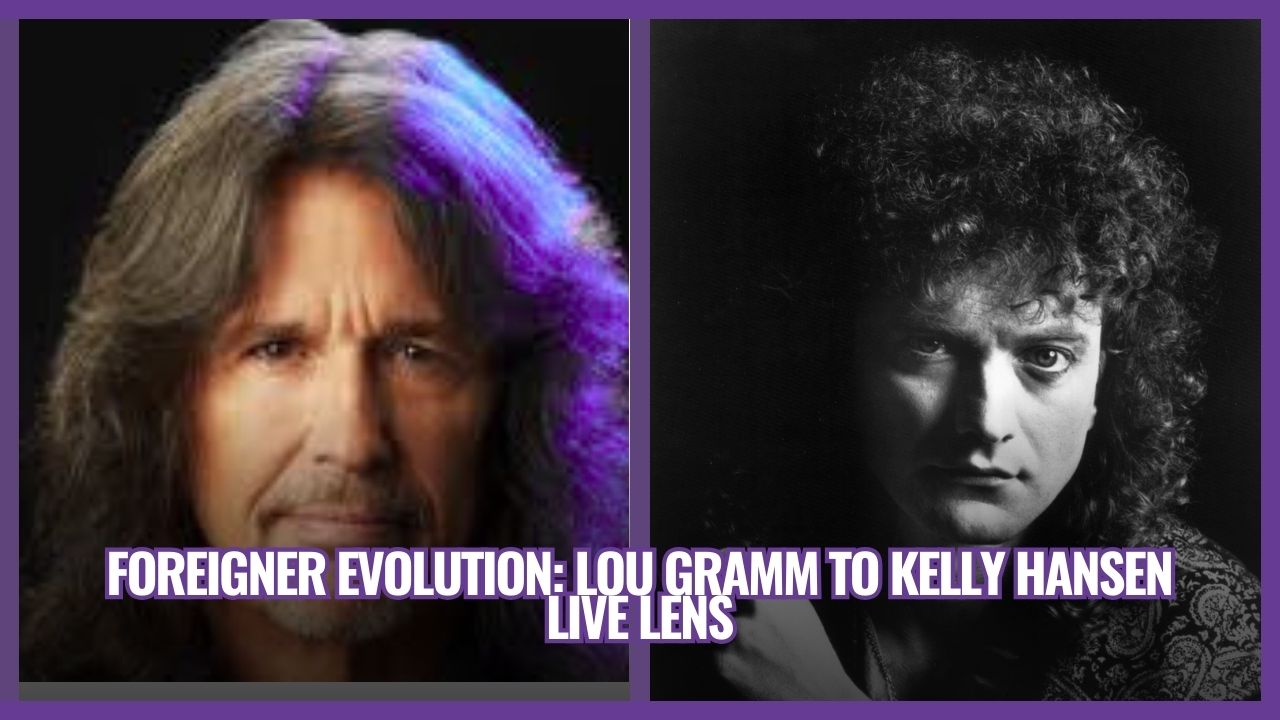
For a photographer, time is not measured in years—it is measured in moments. Over the course of eight years and 27 concerts, I stood in the front row documenting one of rock’s most enduring bands, Foreigner. Through my lens, I witnessed not only performances, but an evolution: from the towering legacy of Lou Gramm to the modern, high-octane stage command of Kelly Hansen.
This visual journey is not about comparison for the sake of nostalgia—it is about understanding how a band reinvents itself while preserving its sonic identity. Each era tells a different story in light, motion, and emotion.
Capturing Two Voices of the Same Legacy
Lou Gramm’s voice defined an era. Even in photographs, you can see the weight of his vocals—his posture grounded, his grip on the microphone steady, his focus inward. When reviewing archival imagery and live footage from his time, what stands out is restraint. The power was in the delivery, not the movement. Gramm often occupied a fixed position, letting the music carry the drama.
Kelly Hansen, by contrast, performs with kinetic energy. From 2015 through 2023, my camera rarely found him still. He runs the stage, leans into the crowd, climbs risers, and interacts constantly with bandmates. Photographing Hansen requires anticipation—shooting on burst mode, tracking motion, and adjusting to rapidly changing angles.
From a technical standpoint, this shift changed how I worked:
- Faster shutter speeds to freeze movement
- Wider focal lengths to capture full-stage motion
- Continuous autofocus for dynamic tracking
The voice may differ in tone, but the visual storytelling has become far more physical.
Stage Presence: Command vs. Connection
Gramm’s presence was commanding in a traditional rock-frontman sense. He stood as the focal point, the voice at the center of a structured band formation. Photographically, this produced strong, symmetrical compositions—lead singer centered, guitarists flanking, drums elevated.
Hansen’s presence is immersive. He dissolves that traditional structure by moving across it. The result is asymmetry, diagonal compositions, and layered depth. Many of my favorite shots from 2015–2023 show Hansen in the foreground with the band exploding behind him in light and color.
Where Gramm projected authority, Hansen projects accessibility. One looks like a rock icon; the other looks like he’s inviting you onto the stage.
Fan Reactions: Then and Now
Through the lens, audiences tell their own story.
Archival imagery of Gramm-era crowds shows a sea of raised lighters, fixed gazes, and collective awe. The relationship between performer and audience was reverential. Fans watched.
From 2015 onward, I photographed something different: fans filming on phones, singing along at full volume, reaching toward the stage as Hansen moved closer to them. The barrier between artist and audience feels thinner now.
One of my most memorable frames from a 2018 show captured three generations in a single shot—a grandfather, his son, and a teenage granddaughter all singing “I Want to Know What Love Is.” That image represents the band’s continuity more powerfully than any lighting rig.
Lighting and Production: From Spotlight to Spectacle
Lighting design has transformed dramatically across eras.
In Gramm’s time, lighting was functional—spotlights, color washes, and minimal movement. This created high-contrast portraits with dramatic shadows. For a photographer, it meant working within narrow exposure windows and relying heavily on timing.
Between 2015 and 2023, Foreigner’s production evolved into a full visual experience:
- LED backdrops
- Moving head fixtures
- Layered color palettes
- Audience lighting during choruses
This introduced both opportunities and challenges. Backlighting created striking silhouettes, but also required careful exposure compensation. Rapid color changes demanded constant white balance adjustments. Smoke effects added atmosphere while complicating autofocus.
The modern show is more cinematic—and photographing it feels closer to shooting a live film than a static performance.
Performance Style: Precision vs. Momentum
Gramm’s era emphasized vocal precision and musical structure. Movements were deliberate, and the band maintained a tight formation. Photographs from this period often feel timeless—clean lines, clear subject separation, and classic rock iconography.
Hansen’s era emphasizes momentum. Songs flow into one another with minimal pause. Guitarists cross the stage. Drummers are elevated within elaborate lighting grids. The visual rhythm mirrors the musical pacing.
As a photographer, this means thinking in sequences rather than single frames. Many of my strongest images are part of a narrative burst—Hansen running toward the crowd, turning into a spotlight, and landing on a sustained note.
Personal Memories from 2015–2023
Standing in the front row for 27 concerts creates a relationship not just with the band, but with the ritual of performance.
I remember:
- The heat from stage pyrotechnics hitting my camera body
- The vibration of bass frequencies traveling through the barricade
- The split-second eye contact from Hansen before a chorus hit
One night in particular stands out. During the final chorus of “Juke Box Hero,” the lights flooded the audience instead of the stage. I turned my lens away from the band and captured thousands of faces illuminated in unison. That photograph became one of the defining images of my book, 8 Years 27 Concerts 2015–2023 Foreigner Live. It wasn’t about the band—it was about what the band creates.
Another moment came in 2022 when a sudden lighting change plunged the stage into deep blue mid-song. I had to adjust settings instinctively without taking my eye off the viewfinder. The resulting silhouette of Hansen against a halo of light remains one of my most technically satisfying shots.
These are not just memories; they are lessons in timing, adaptation, and storytelling.
The Photographer’s Perspective on Evolution
What fascinates me most is not which era is “better,” but how each era demands a different photographic language.
Lou Gramm’s Foreigner is photographed like classical rock: composed, iconic, and vocally centered.
Kelly Hansen’s Foreigner is photographed like modern live performance: dynamic, immersive, and visually kinetic.
Yet the emotional core remains unchanged. When the opening chords hit and the crowd rises, the same connection exists across decades.
That continuity is what my camera has tried to preserve.
A Living Archive of Rock History
Photography is often described as freezing time, but in reality it reveals change. Over eight years, my work has become a visual timeline of a band that refuses to stand still.
From controlled spotlights to moving galaxies of light, from grounded vocals to full-stage motion, from watching audiences to participating ones—this evolution is not a departure from the past but an expansion of it.
Through the lens, Foreigner is both memory and momentum.
And as long as the music plays, I will remain where the story is clearest—front row, camera in hand, capturing the next chapter.